
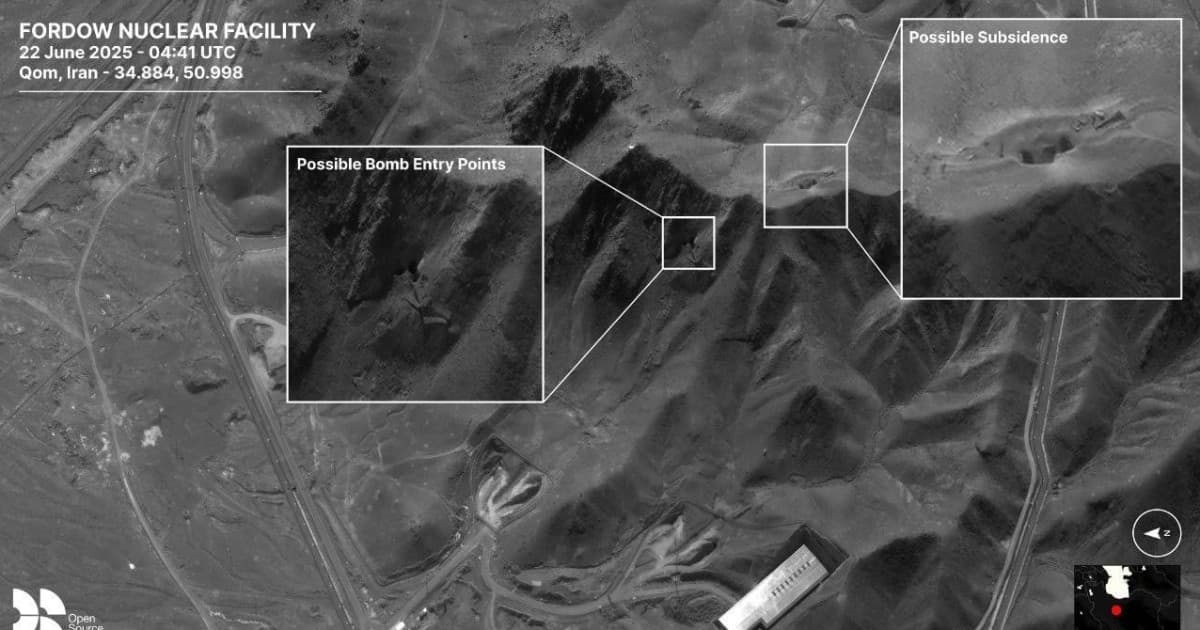
Seventy-five devices, including 14 GBU-57 bombs and 30 Tomahawk missiles launched from Navy submarines. “We have devastated the Iranian nuclear program,” Pentagon chief Pete Hegseth said in an early morning press conference in Washington. Yet the rain of fire that fell on the nuclear facilities at Natanz, Fordow and Isfahan may not have completely disabled the facilities used by Tehran for uranium enrichment. While we wait to understand what the actual toll of Operation “Midnight Hammer” will be, the indications that have come in so far seem to point in this direction.
The damage has been documented. An analysis of satellite images by CNN found that US air strikes on the Fordow facility, which is built between 80 and 90 metres underground, appear to have left at least six large craters on the ground, indicating the use of “bunker buster” depth charges. Images captured by satellite company Maxar showed six distinct, visible impact craters in two locations near the site. Satellite images also showed significant changes in the colour of the mountainside that hosts the site, indicating that a large area was covered in a layer of grey ash following the attacks. Access points to the facility’s tunnels are “completely blocked,” Qatari broadcaster Al Jazeera reported, and the air defence system was “destroyed”. At the moment, however, the extent of the damage to the underground structure is unclear.
Hours after the attack, however, the International Atomic Energy Agency reported on X that “there are currently no reports of increased radiation levels outside the sites. The IAEA will provide further assessments of the situation in Iran as new information becomes available.” “There are no reports of radiation around the nuclear sites,” Iran’s state-run Atomic Energy Agency spokesman Behrouz Kamalvandi confirmed shortly afterward. “They should know that this industry has roots in our country and that the roots of this national industry cannot be destroyed,” Kamalvandi said, while admitting that, “of course, we have suffered damage, but this is not the first time that the industry has suffered damage.” Now efforts to develop the civilian nuclear sector will continue: “Considering our capabilities, the nuclear industry must continue to operate.”
Aside from the radiation issue, Tehran is downplaying the results of the entire operation. According to the official news agency Tasnim, the Fordow site, the main facility and symbol of Iran's nuclear program, suffered only partial damage."The situation in the surrounding area is normal, life continues as usual, there is not even smoke or signs of fire. Provincial officials deny Trump's statements about the destruction of the Fordow facility and report only partial damage," the agency reports. Furthermore, according to Hassan Abedini, deputy political director of the Islamic Republic of Iran Broadcasting (IRIB), “Iran has long ago evacuated its three nuclear sites at Fordow, Natanz and Isfahan, in anticipation of an external attack” and all sensitive nuclear material “had been removed from the facilities to prevent a nuclear disaster from occurring.”
Tel Aviv has a different view on the issue. The Israeli defense establishment is satisfied with the attack and estimates that the Natanz plant was “ completely destroyed .” According to military intelligence, Channel 12 news reported, the enriched uranium was stored in Natanz and Isfahan and the vast majority was not taken out of the sites, so it was there at the time of the attack: “The current lack of precise information on the real result of the American attack on the Fordow and Isfahan plants is due to the fact that both sites are located deep underground and not from fears that something went wrong during the attack. The final assessment will tell whether the nuclear program has regressed or has been completely annihilated.”
Fears of possible radioactive leaks continue. In the early afternoon, the news agency Shargh reported, a “massive” explosion was heard in the southern Iranian province of Bushehr, which is home to a nuclear power plant. The same agency added that two localities around the city had been “attacked by the Zionist regime”. Another explosion, it reported, occurred in the central province of Yazd. The IAEA had warned on Friday that a direct attack on the Bushehr nuclear power plant would have “serious”
consequences, potentially releasing large amounts of radiation into the environment.