
The Ukraine settlement plan, which US President Donald Trump has put in his name, was priced at pure business profit for the United States, but as it later turned out, its text was written by Russians. “One hundred billion dollars of frozen Russian assets will be invested in a US-led reconstruction and investment program in Ukraine. The US will receive 50 percent of the profits of the venture,” reads point 14 of the settlement plan. In contrast, “Europe will increase the amount of investment available for the reconstruction of Ukraine by another hundred billion dollars.” At the same time, the plan would ensure that the Russians can also win in business: “The remaining part of the frozen Russian funds will be invested in a separate US-Russian investment vehicle that will implement joint projects in specific areas.” If all this were not revealing enough, the first and most important paragraph of point 10 of the same 28-point document is about the US receiving compensation in exchange for security guarantees provided to Ukraine.
The points formulated by Kirill Dmitriev, a confidant of Russian President Vladimir Putin, show that the Kremlin also understands that Trump can be reached and influenced through his wallet, in addition to his ego. The 28 points are intended to show Washington that the country's investors can also participate in projects in Russia that offer even greater opportunities, after Ukraine signed a treaty with the US in April this year, which was ceded to Kiev, on cooperation in the exploitation of the country's natural resources and post-war reconstruction.
However, it is not yet possible to predict whether the Kremlin is serious about involving the Americans, or whether the policy is simply aimed at preventing new American sanctions against Russia until – as Moscow hopes – the Russian army wins the war against Ukraine that began almost four years ago.
The document that practically forced Ukraine to surrender completely has been removed from the agenda in this form, but
Trump's spirit of mistrust lives on in the new settlement plans and in the negotiations between the Russians and the Americans.
The Europeans' counter-plan – which served as the basis for the document developed by American and Ukrainian politicians in Geneva at the end of November – also puts the USA in a privileged position: according to it, the USA will cooperate with Ukraine in the restoration, development and operation of the country's gas infrastructure, as well as in the reconstruction of settlements and other infrastructure, and in the extraction of mineral and other natural resources.
The situation is similar in the case of Russia. “The United States will conclude a long-term economic cooperation agreement with Russia for the purpose of joint development in the fields of energy, natural resources, infrastructure, artificial intelligence, data centers, rare earths, joint projects in the Arctic, and other mutually beneficial business opportunities,” the text states.
The Americans are already in the Russian pantry
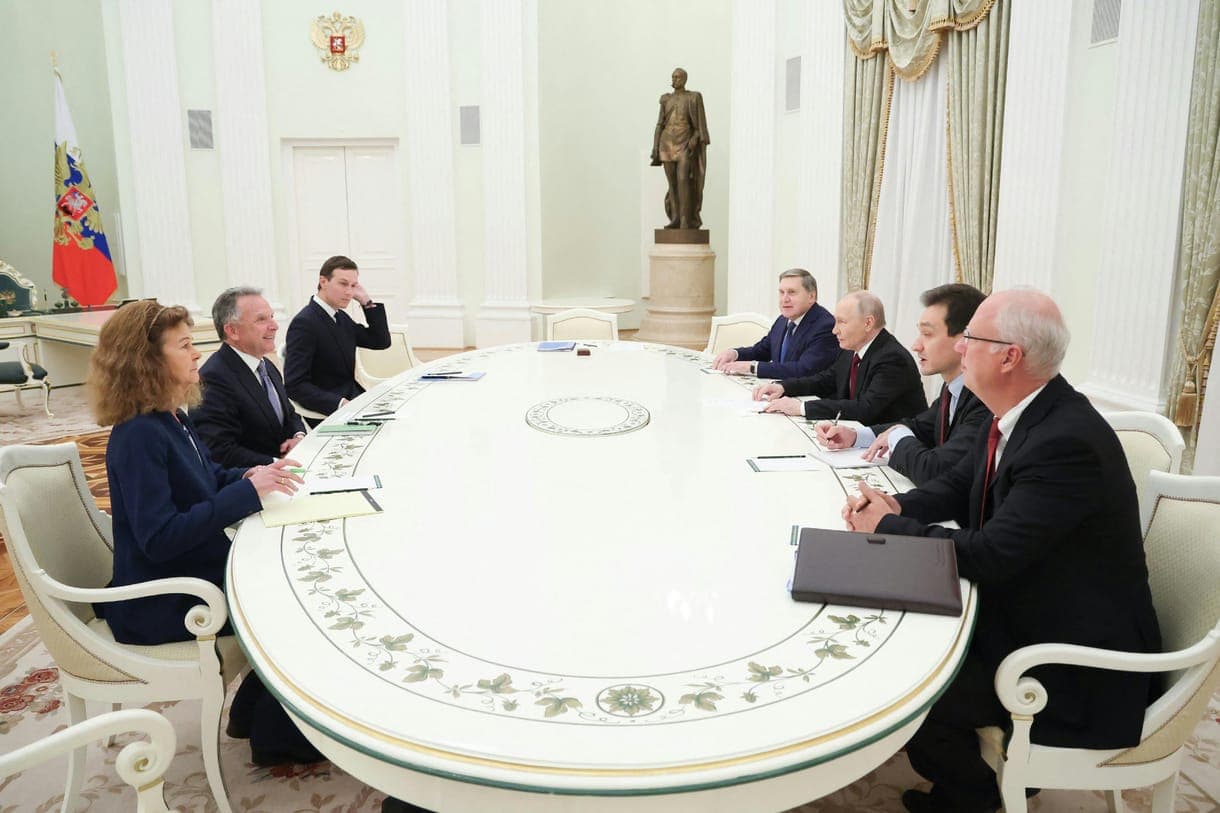
While negotiations between the US, Russia, Ukraine and the Europeans are currently taking place in various formations, which do not offer much hope, the Americans are already “in the Russian pantry.” According to the Wall Street Journal, Dmitriev and Trump’s special envoy, Steve Witkoff, and the president’s son-in-law, Jared Kushner, in addition to formulating the 28-point plan, also discussed how to bring the Russian economy back into the global economy in a way that benefits the US, not the Europeans, the most.