

The EU plans to cover €90 billion ($105 billion) of Ukraine’s estimated €135 billion ($161 billion) financing needs for 2026-27, European Commission President Ursula von der Leyen said at a press conference while presenting the EU’s new support proposals.
The statement is the first official confirmation of the exact sum earmarked for Ukraine over the next two decisive years, ahead of its shift into the EU’s regular financing system. It comes as Russia’s full-scale war grinds on – long past the point many in the West assumed it would end.
Von der Leyen said Ukraine faces a “critical juncture” as peace-related negotiations continue while Russia intensifies its attacks, raising both civilian and military financing needs.
The International Monetary Fund (IMF) projects that Ukraine will require €135 billion ($161 billion) over the next two years to maintain public services and sustain its defense effort.
If spread over two years, the figure aligns with Ukraine’s own Ministry of Finance estimates. Ukraine is expected to receive $37.4 billion in international financing over that period, but “the same amount remains uncovered,” the ministry previously told Kyiv Post.
The ministry said Ukraine will need $74.8 billion to cover 2026-27 if Russia’s war continues into 2026. The final figure for 2026 alone is expected to be even higher, with Ukraine requiring “almost $45 billion,” on top of obligations to service public debt, the ministry’s press service added.
Finance Minister Serhiy Marchenko, speaking at the government’s briefing in August, said Ukraine will need $45 billion for 2026 alone.
Two options: EU borrowing or reparations loan
The European Commission outlined two options for member states to help finance Kyiv:
- EU borrowing, backed by the EU budget and provided to Ukraine as a loan. This option requires unanimous approval.
- A reparations loan, funded by the cash balances generated by immobilized Russian central bank assets in the EU. This option may be approved through qualified-majority voting.
With the proposed reparations loan, Ukraine would repay the funds only “if and when Russia is paying reparations,” von der Leyen said. The plan would require financial institutions holding Russia’s frozen cash balances to channel them into the loan.
Use of funds: budget support, defense production
Von der Leyen said the financing would be directed toward budget support through existing mechanisms – such as macro-financial assistance or the Ukraine Facility – as well as military support, particularly to strengthen Ukraine’s defense-industrial capacity and integrate it with Europe’s defense base.
Von der Leyen said military funding would follow a “cascading principle,” prioritizing purchases from Ukraine, EU member states, and EEA/EFTA countries including Iceland, Liechtenstein, and Switzerland.
Procurement outside these jurisdictions would be permitted only when urgent needs cannot be met internally.
Safeguards for Belgium and others
Von der Leyen acknowledged Belgium’s concerns regarding Euroclear, the main holder of immobilized Russian assets. She said the European Commission incorporated “very strong safeguards” to minimize legal and financial risks.
These include protections against the enforcement of illegitimate foreign court rulings, a solidarity mechanism allowing the EU to share residual risks among member states, and additional risks not specified by von der Leyen.
Von der Leyen said the measures are designed to help Ukraine resist Russian aggression and enter peace negotiations from a position of strength. She added that increasing the cost of Russia’s war through the reparations loan serves as “an invitation to come to the negotiation table.”
Kyiv’s urgent finance needs
The EU confirmed the figure after over six months of negotiations on how to finance Ukraine.
Defense and security expenditures continued to dominate the budget, accounting for 70.5% ($61.7 billion) of total spending in the first nine months of 2025, according to estimates by the Kyiv School of Economics (KSE).
Russia’s ongoing war has forced Ukraine to spend more each year to defend itself.
The KSE Institute previously estimated Ukraine’s projected budget deficit at $46.3 billion for 2026.
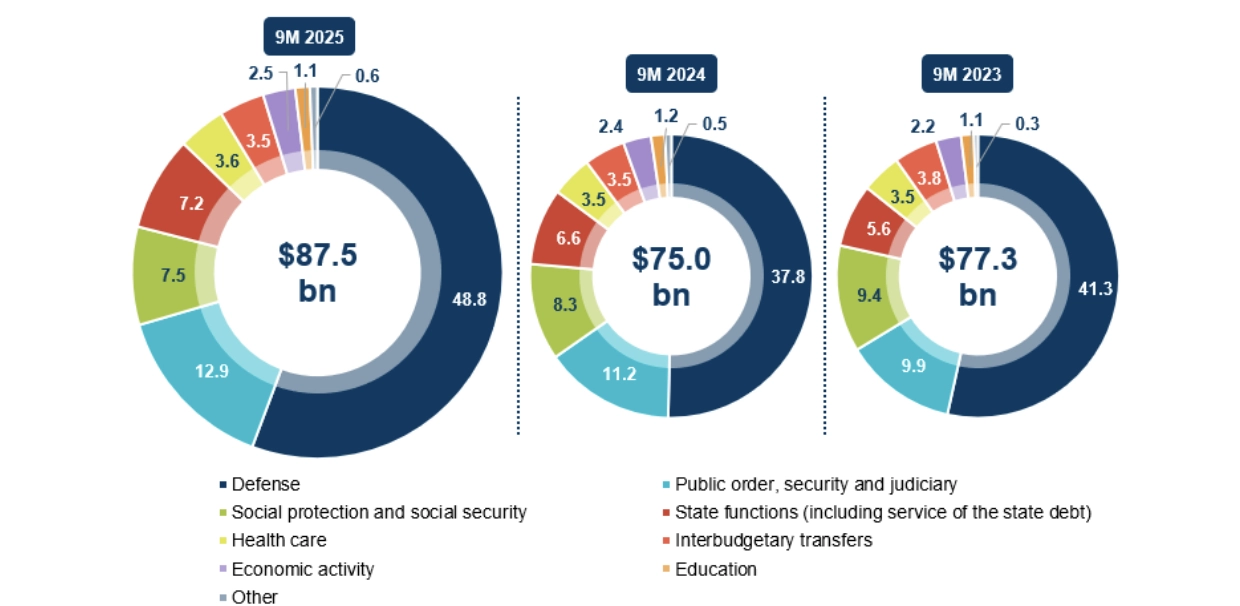
Social wages, critically needed during wartime, are supported by international financial aid, including the Extraordinary Revenue Acceleration (ERA) loan, which is backed by profits from frozen Russian assets, as well as support from the EU and IMF.