
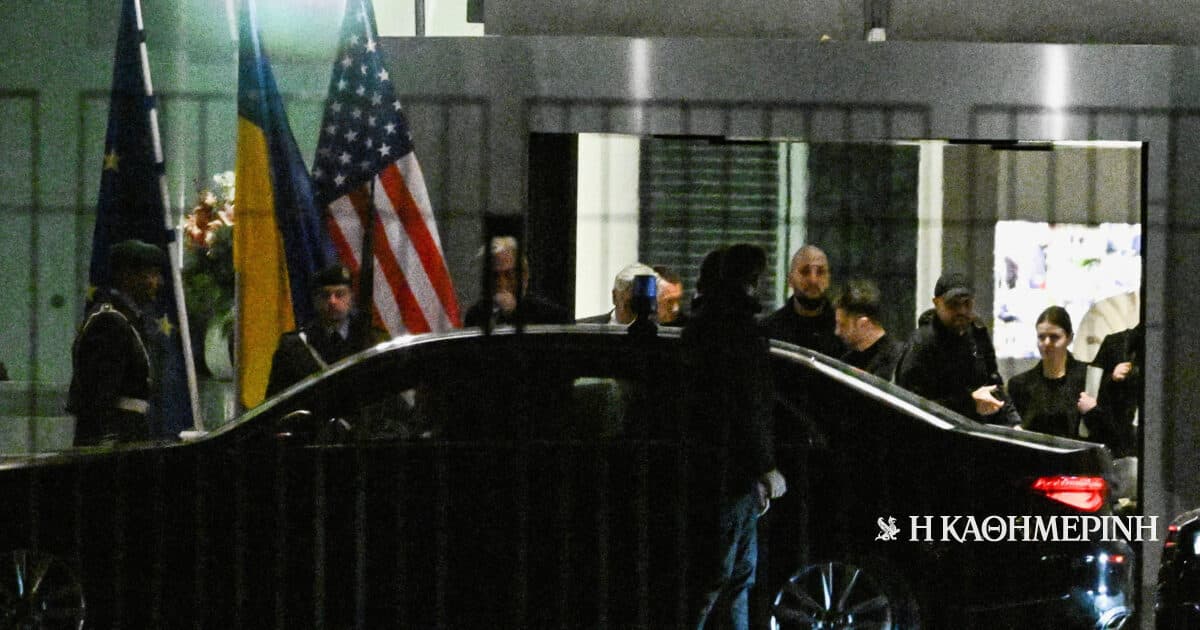
Article 5-style security guarantees were at the heart of negotiations on Ukraine, according to a senior US official, who spoke of substantial progress in Berlin talks between Ukraine, the United States and European partners.
As the same source reported, the American side is seriously considering a framework of security guarantees similar to Article 5 , which, according to President Donald Trump's assessment, could also be accepted by Russia as part of a final agreement.
These guarantees, as clarified, will include supervision, prevention and crisis management mechanisms, while any violations will be addressed within the framework of the security package itself.
The official noted that any such agreement would have to pass through the US Senate and that President Trump appears willing to follow that process.
He stressed, however, that the guarantees will not remain on the table indefinitely , underlining the need for timely decisions.
According to the same source, the issue of territorial sovereignty remains open, with the final decision belonging to Ukraine.
Despite the disagreements, it is estimated that approximately 90% of the individual issues between Russia and Ukraine have already been resolved, although serious gaps still exist, including with regard to energy infrastructure and especially power plants.
The talks also included deeper discussions on the territories, with the American side noting that Trump remains committed to the goal of preventing further Russian advance towards the West.
At the same time, ways to avoid mistakes from previous agreements were examined, as well as economic reconstruction scenarios.
In the economic aspect, according to the official, the utilization of frozen Russian funds was discussed with the aim of financing the reconstruction of Ukraine, the creation of a free economic zone, as well as strengthening the country's financial stability.
In this context, contacts were made between the Ukrainian side and teams from BlackRock.
Both BlackRock and the World Bank are working on measures that will make Ukraine economically viable.
The same official said that from the European side there were clear indications of strong financial support.
At the diplomatic level, it was noted that Russia appears open to the possibility of Ukraine joining the European Union, while the assessment was expressed that Moscow could ultimately accept the proposed security guarantees within the framework of a comprehensive agreement.
The American official described the talks in Berlin as very positive, speaking of consensus on a number of issues, while those issues that remain open have been referred to working groups.
He also stressed that the contribution of the European representatives has been excellent and that Trump is satisfied with the progress of the negotiations, expressing hope that the talks are now on a path to peace.
In this context, a working dinner is planned with Ukrainian President Volodymyr Zelensky, at which the next steps will be discussed, with Donald Trump participating by telephone.
At the same time, a working group meeting is scheduled in the United States next weekend, while, as noted, the American side states its readiness to travel to Russia, if deemed necessary.
Zelensky: Territorial disagreements, goal is a strong peace
Ukrainian President Volodymyr Zelensky said that Ukrainian negotiators will continue talks with the US delegation, as part of intensive contacts on a possible peace agreement.
He acknowledged that there are different positions between the sides on the issue of territories, but stressed that Kiev remains committed to the process. He said that Ukraine is ready to work towards a strong peace agreement.
Impasse for Donetsk
Despite progress on the security issue, the territorial issue is emerging as the biggest thorn in the negotiations.
American negotiators made it clear to the Ukrainian delegation that, as part of a peace agreement, Ukraine would have to withdraw its forces from the eastern Donetsk region.
According to an official with direct knowledge of the talks, the Ukrainian side responded that further discussions were required, while the issue remained unresolved during the second day of contacts.
A second source said that there are still significant gaps in the positions of the two sides on the territorial issue.
The talks are taking place under the direct involvement of Zelensky, who met in Berlin with US envoy Steve Witkoff, Trump's son-in-law Jared Kushner, as well as European leaders.
The Secretary of the National Security and Defense Council of Ukraine, Rustem Umerov, spoke of constructive and productive negotiations with real progress, emphasizing that the American team is working in an extremely constructive manner towards a sustainable peace agreement.
The Ukrainian government has already stated that it is willing to abandon its NATO membership goal if it receives strong Western security guarantees.
From Moscow, Kremlin spokesman Dmitry Peskov repeated that Ukraine's non-membership in NATO is a fundamental issue for any peace settlement and that Russia expects an update from the US after the talks.
Russia claims to have annexed Donbass, which includes the Donetsk and Luhansk regions, as well as other areas, including Crimea, claims that Kiev and its European allies reject.
Russian forces do not fully control all of the territory claimed by Moscow, including about 20% of the Donetsk region.
At the same time, Zelensky is called upon to balance the need to appear flexible towards the Trump administration and the risk of accepting concessions that Ukrainian society is not prepared to accept.
A poll by the Kiev International Institute of Sociology shows that 75% of Ukrainians completely reject an agreement that would include the concession of more territory or the limitation of the army without clear and binding security guarantees, although 72% say they are willing to accept an agreement that would freeze the current front line with some compromises.
The talks in Berlin come at the start of a crucial week for Europe, with the EU summit due to decide whether to guarantee a large loan to Ukraine using frozen Russian assets.
In Berlin, the President of the European Commission Ursula von der Leyen, the Secretary General of NATO Mark Rutte, and the leaders of France, Britain, Italy, and Poland are expected to participate, among others, in an effort to maintain European cohesion at a time when the Ukrainian issue is entering a particularly sensitive turning point.
Merz: Opportunity for a real peace process
Chancellor Merz spoke of the greatest opportunity that has presented itself since the start of the war in Ukraine to begin a real peace process, underlining the decisive role of the United States and Donald Trump in the latest developments.
As he stated, without Trump we would not have achieved the positive momentum of the last few hours, adding that the US has made a notable material contribution to the security guarantees discussed in the negotiations.
The Chancellor stressed that the territorial issue remains key to any agreement, noting, however, that only Ukraine can decide on any territorial concessions.