
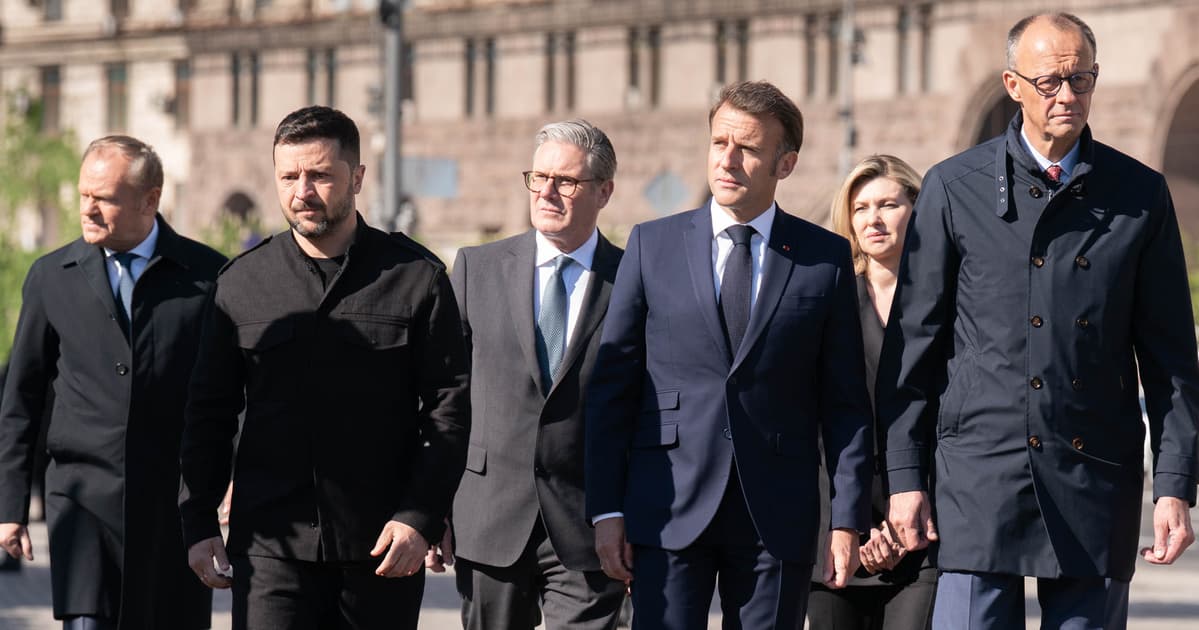
French President Emmanuel Macron has warned that the United States could betray Ukraine, according to a leaked transcript of a phone call between European leaders on how to protect Kiev. The call took place on Monday and included German Chancellor Friedrich Merz, NATO Secretary-General Mark Rutte, Finnish Alexander Stubb and Ukrainian President Volodymyr Zelensky. The leaders also discussed U.S.-led peace talks between Kiev and Moscow.
There is a possibility that the United States will betray Ukraine on the territorial issue without providing security guarantees to Kiev
− Macron said, according to Spiegel, adding that Zelensky was in great danger. The French presidential office denied in a statement that the head of state had spoken of any betrayal. “The president did not use these words,” the office wrote.
Friedrich Merz said the Ukrainian president “must be extremely careful in the coming days.” The German chancellor said American negotiators Steve Witkoff and Jared Kushner were playing both Zelensky and European leaders, who met for five hours with Russian President Vladimir Putin on Tuesday. The German chancellor’s spokesman, Stefan Kornelius, said he would not comment on what was said in the conversation.
Finnish President Alexander Stubb agreed with Merz's thoughts, according to the transcript."We cannot leave Ukraine and Volodymyr (i.e. Zelensky) alone with these guys," he said, apparently referring to Witkoff and Kushner, a view shared by NATO Secretary General Mark Rutte.
Spiegel also reported that in addition to those listed, European Council President António Costa, European Commission President Ursula von der Leyen, Polish Prime Minister Donald Tusk, Italian Prime Minister Giorgia Meloni, Danish Prime Minister Mette Frederiksen and Norwegian Prime Minister Jonas Gahr Støre also participated in the call. The issue of frozen Russian assets was also discussed during the call, with some European leaders insisting that the seizure of these funds to finance a financial and military aid package for Ukraine falls within the competence of the European Union, not the United States.
This is how Donald Trump's peace plan is shaping up
The international peace plan aiming to end the war in Ukraine has been in the making for weeks, often amidst controversial and intense diplomatic twists and turns. The original 28-point proposal, prepared in cooperation between the US and Russia, was criticized by many for its excessive emphasis on Russian interests: among other things, it demanded the withdrawal of Ukrainian troops from the Donetsk region, would have recognized that certain disputed territories would remain under Russian control, would have limited the size of the Ukrainian army, and would have permanently excluded Ukraine from NATO membership.
Due to the European repercussions and strong protests from Kiev– Washingtonmodified
the original plans. According to reports, the new version is more permissive: it includes a higher number of Ukrainian troops and no longer categorically prohibits NATO membership, but ties it to the consensus of the alliance's members. Territorial issues remain unresolved. Zelensky indicated that the new version better fits Ukraine's position, but he plans to discuss the most sensitive points with Donald Trump personally.Europe came up with its own proposal
While Washington and Moscow continued to negotiate, Britain, France, and Germany prepared their own alternative plan. This fundamentally rewrote the 28-point American proposal, deviating from it on several points. The most important difference is that the European version does not rule out Ukraine's future NATO membership, only citing, as mentioned above, the current lack of unanimous support from member states.
Macron spoke out against limiting the size of the army, while Merz warned that the continent's leaders cannot be left out of European security policy matters. In contrast, Hungarian Foreign Minister Péter Szijjártó continued to urge Europe to unconditionally support the original Trump proposal, saying any deviation would only worsen the chances of peace.
The negotiations continued, this time in Moscow.
In addition to the phone call on Monday, another meeting took place on December 2nd, this time in Moscow, where Kirill Dmitriev, US special envoy Steve Witkoff and Donald Trump's son-in-law Jared Kushner participated. Before the meeting, Vladimir Putin spoke at an investment forum, where he said that Europe's negotiating agenda does not include peace, that they are pro-war, and even make demands regarding the war in Ukraine, which is unacceptable to Moscow.
The Europeans are also preventing the US leadership and President Trump personally from reaching a peace agreement through negotiations. The statements clearly inciting discord between Europe and Washington seemed rather strange just a few hours before the planned Russian-American talks. He concluded his speech by saying that if Europe wants war, we are already ready.
In contrast, Volodymyr Zelensky wrote on his social media page that, following the visit of the American team to Moscow and consultations in Washington, Defense Minister Rustem Umerov, Andriy Khnatov, and other members of the negotiating delegation will continue consultations with President Trump's envoys. He added that a dignified peace is possible only if Ukraine's interests are taken into account. He said that the world now clearly feels that there is a real opportunity to end the war, but the current diplomatic activity must be supported by pressure on Russia.
The events of the Russian-Ukrainian war are being followed minute by minute by the Index, which you can access by clicking here.