
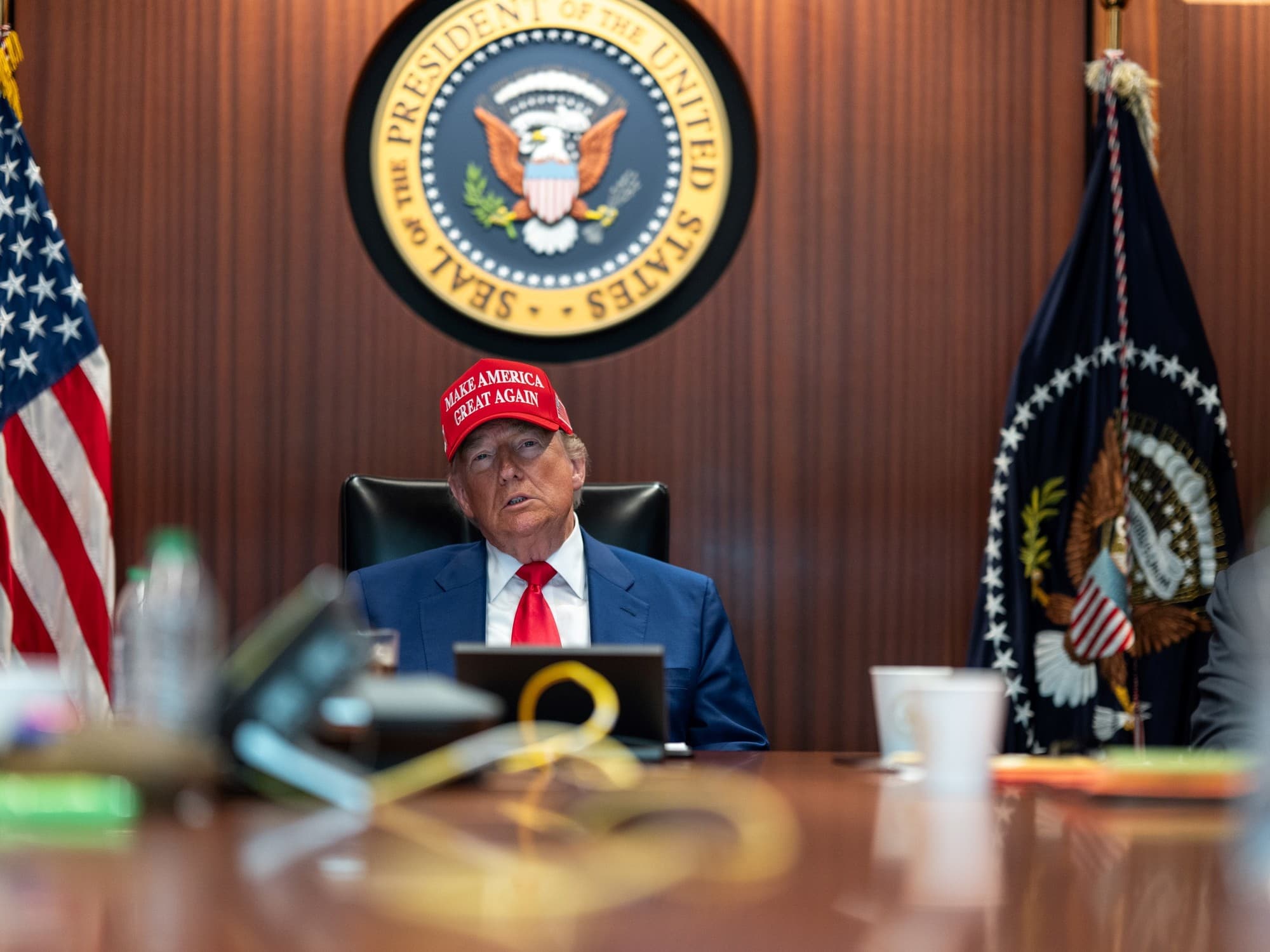
As President Donald Trump settled into his New Jersey golf club Friday night, planes carrying some of the world's most sophisticated bombs were poised to take off. But the White House chief of staff—according to friends who regularly accompany him on his golfing and social outings—showed no signs of anxiety about his decision and appeared relaxed despite authorizing airstrikes against three Iranian nuclear facilities, a historic move that could have profound ramifications for U.S. national security and his own legacy as president.
The B-2 stealth bombers carrying 30,000-pound bunker-busting bombs capable of piercing up to 200 feet of concrete finally took off at midnight from their base in Missouri, heading east for the Fordow, Natanz, and Isfahan bases in Iran. Another group of planes headed west, a deliberate attempt to divert attention while Trump demanded total secrecy for his momentous decision.
Trump, meanwhile, continued his social activities at his golf club. He was escorting Sam Altman, the chief executive of OpenAI, to a new members event in one of the clubhouse dining rooms. He appeared relaxed and, at least publicly, in good spirits, people who were there said.
Twenty-four hours later, on Saturday at 6 p.m. Washington time, Trump interrupted his weekend of golf and settled into the Situation Room in the basement of the White House, wearing a red"Make America Great Again" cap, while the execution of"Operation Midnight Hammer" unfolded in real time on the huge screens in that bunker.
Hours later, Trump announced that “the attacks were a spectacular military success” and that the bases had been “completely and totally destroyed.”
However, Pentagon officials said Sunday that Iran's nuclear sites suffered"severe damage" and that it was too early to say whether Iran still retained any capability to enrich uranium.
In fact, Trump tweeted again this Sunday that the damage to Iran's nuclear sites is"monumental." "The strikes were hard and precise," he said, and stopped short of mentioning total destruction.
In a press conference Sunday morning detailing the operation, Defense Secretary Pete Hegseth told reporters that the United States is “not seeking war” with Iran, but rather its goal was to destroy its nuclear facilities.
A satellite image provided by Maxar Technologies shows the Natanz nuclear enrichment plant after the US airstrikes, in Natanz, Iran, on June 22. EFE photo
And he clarified that the attacks were not aimed at dethroning Iran's supreme leader, Ayatollah Ali Khamenei."This mission was not and has not been about regime change," Hegseth said.
However, Trump later added to the confusion with a post on his social media:"It is not politically correct to use the term 'regime change,' but if the current Iranian regime is incapable of MAKING IRAN GREAT AGAIN, why wouldn't there be a regime change??? CRUM!!," for "Make Iran Great Again," a play on his campaign slogan.
Days ago, Trump had said they knew where Khamenei was hiding and could kill him if they wanted, but he said they wouldn't do so"for now."
Message to the regime
Amid fears of a broader regional conflict, the Trump administration sent a clear message that it wanted to restart diplomatic talks with Iran. “Let’s meet directly,” Secretary of State Marco Rubio said in an interview with CBS. He added that “there are no military operations planned right now against Iran, unless they cause trouble and attack” U.S. interests.
But Tehran signaled that the time for diplomacy had passed and that they had the right to defend themselves. The regime was evaluating options for responding. The decision to go ahead with the attacks thrusts the United States directly into the Middle East conflict, raising concerns about Iranian retaliation. Trump arrived at the decision to attack after much hesitation and back-and-forth between military threats and calls for dialogue, with the ever-present fear that an attack could draw the U.S. into a protracted war.
He also has to deal with the MAGA home front, as he campaigned on a promise to stop wars and avoid getting involved in other far-flung conflicts that would waste money and put American lives at risk.
According to sources close to him, Trump made the decision to attack on Thursday, the same day he instructed his press secretary, Karoline Leavitt, to announce that he was giving Iran two weeks to return to the negotiating table after the Israeli attacks. It was clearly a diversionary maneuver to hide his true plans.
Vice President J.D. Vance said Sunday that Trump retained the ability to suspend the strikes"until the last minute." But he opted to go ahead with the final approval he gave Saturday after receiving reports that Iran was unwilling to return to negotiations after European leaders met with Israeli officials on Friday.
So Trump's two-week public address lasted just 48 hours before he took one of the most significant actions of his presidency. The operation began at midnight Friday, with B-2 bombers taking off from Missouri on an 18-hour flight that was the planes' longest mission in more than two decades, Defense Secretary Hegseth said.
Joint Chiefs of Staff Chairman Gen. Dan Caine said Sunday that some of the B-2s launched from the U.S. flew west as decoys, while the rest"proceeded quietly east with minimal communications during the 18-hour flight."
A file photo released by the Atomic Energy Organization of Iran on November 6, 2019, shows the interior of the Fordow Uranium Conversion Plant in Qom, northern Iran. Photo: AFP
The unprecedented U.S. operation involved seven B2 stealth bombers. In total, more than 125 aircraft participated, including B2s, refueling tankers, reconnaissance aircraft, and fighter jets.
At about 5 p.m. Washington time, Caine said, a U.S. submarine"launched more than two dozen Tomahawk land-attack cruise missiles at key surface infrastructure targets" at the Isfahan nuclear site.
And shortly after, at approximately 6:40 a.m. ET in the Iranian morning, the lead B-2 bomber launched two bunker-busting bombs at the Fordow nuclear site, Caine said, and the remaining bombers then hit their targets, and it was all finalized at 7:05 a.m., when the return home began, Caine said, noting that Iran did not fire at the U.S. on the way in or out.
"This is a plan that took months and weeks of positioning and preparation so we could be ready when the president of the United States called," Hegseth said alongside Caine."It took a lot of precision. It involved diversion and the highest operational security."
PB